Occasionally, we’ve been asked if our cells are able to be used with hemispherical ATR elements. While there is no fundamental reason preventing the use of a hemisphere in one of our cells, the performance of hemispheres is substantially worse than the Face-Angled Crystals (FACs) that we recommend. This performance difference is apparent by looking at the single channel energy spectrum of the two elements:
Figure 1: Energy curves to compare throughput of internal reflection elements.
Both spectra were collected with the same 2 mm aperture and 128 co-additions. The spectrum collected using the FAC had 12 times the spectral power of the spectrum collected with the hemisphere. Both spectra were collected at an angle of incidence of 60 degrees, which was the face angle of the FAC.
The main reason for the difference in throughput is that the hemisphere is a focusing optic, while the planar surfaces of the FAC do not alter the shape of the wavefront. The stock VeeMAX III configuration is designed to focus the beam onto the surface of a flat mirror or the face of a prism, and the extra optical power provided by the curved surface of the hemisphere reduces the amount of light which is directed onto the detector by the mirrors of the VeeMAX. The anti-reflection coating further helps to boost the throughput compared to an uncoated hemisphere by minimizing reflection losses at the two air/Si interfaces.
For more information comparing the performance of a hemispheres and FACs using the VeeMAX II, see the following article:
Sigrist JA, Lins ES, Morhart TA, Briggs JL, Burgess IJ. Optimization of a Commercial Variable Angle Accessory for Entry Level Users of Electrochemical Attenuated Total Reflection Surface-Enhanced Infrared Absorption Spectroscopy (ATR-SEIRAS). Applied Spectroscopy. 2019;73(12):1394-1402. 10.1177/0003702819858353
The topic of preparing internal reflection elements (IREs) for thin film deposition comes up from time to time and we thought it might be helpful to address it in a blog post. The level of cleanliness required depends on the application and the method of deposition. Electrolessly deposited films require scrupulously clean surfaces, while the cleanliness conditions are relaxed somewhat if a conductive metal oxide underlayer is used for electrodepositing a metal film. This short article describes what works for us, but your mileage may vary.
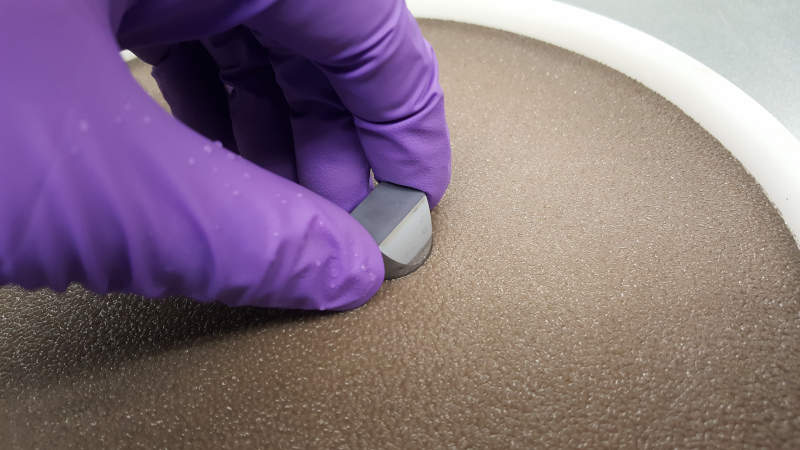
Assuming there are no major visible scratches in the IRE, you shouldn’t need to use any polish coarser than about 3 micron. We use polycrystalline diamond suspensions to polish the crystals, such as the DIAMAT line of products from PACE Technologies (no affiliation with Jackfish SEC). We polish in two steps: first with 3 micron, and then follow it with 0.5 micron. It’s possible to go even finer if your application calls for it. A cloth polishing pad is wetted and charged with the polish. Separate polishing pads should be used for each different grit. Applying light pressure and using a figure-8 motion, the crystal is lapped against the polishing pad. Too much water may cause the crystal to hydroplane across the surface of the pad without any polishing action.
It’s important to take care to avoid contaminating the finer grits with larger abrasive particles. When changing grits, it’s a good idea to take a new pair of gloves and wipe down the work surface. Long sleeves can be a culprit for transferring abrasive particles, so it’s best to roll them up or avoid baggy sleeves.
IREs can take several different forms: hemispheres, face-angled crystals (FACs) or even micromachined silicon wafers. The grooved wafers are rather fragile and difficult to hold on to while polishing. Instead, the wafers can be immersed in a solution of aqua regia (3 parts HCl to 1 part HNO₃) to strip off any metal or conductive metal oxide on the surface. After mixing the aqua regia, wait for it to cool down to room temperature. In our experience, immersion in room temperature aqua regia for 5 minutes with gentle swirling is sufficient to completely remove a 25 nm thick ITO layer . Aqua regia can be used on FACs as well, however it should not be used on crystals which have an anti-reflection coating, since this can be damaged by concentrated acids. Also, one should never use acid to clean a ZnS or ZnSe prism which will dissolve the crystal and release toxic gases.
After removing the coating from the IRE (either chemically or by polishing), we typically ultrasonicate in ethanol and then in water using a Teflon beaker so that the crystals don’t chip against the side of the beaker. After each step, we rinse with copious millipore water and blow dry with clean, dry air or inert gas from a cylinder.
Considerations for conductive metal oxide coatings
In a previous post, we discussed our preferred method of using conductive metal oxide underlayers (such as ITO) as a means to electrodeposit metal films from electrolytes containing metal ions. If you have an ITO-coated IRE with electrodeposited metal, it can often be reused several times. Extended contact with electrolyte causes ITO layers to fail, so it’s best to disassemble the cell and store the ITO-coated IRE dry between experiments. Rinse the top surface with millipore water to remove residual electrolyte and blow dry gently with inert gas. Make sure nothing brushes against the top of the film (the lower o-ring can be a culprit), since this can damage the metal film which is fairly delicate.
If the SEIRAS performance starts to decline, or if you want a new metal film, it may be possible to remove the metal while retaining the ITO . Our electrodeposited metal films can be removed by gentle polishing with 0.5 micron grit for a short time while keeping the ITO intact. This may not be ideal from a contamination standpoint, although if you’re in a bind, it can extend the use of an IRE without requiring access to vacuum-deposition equipment.
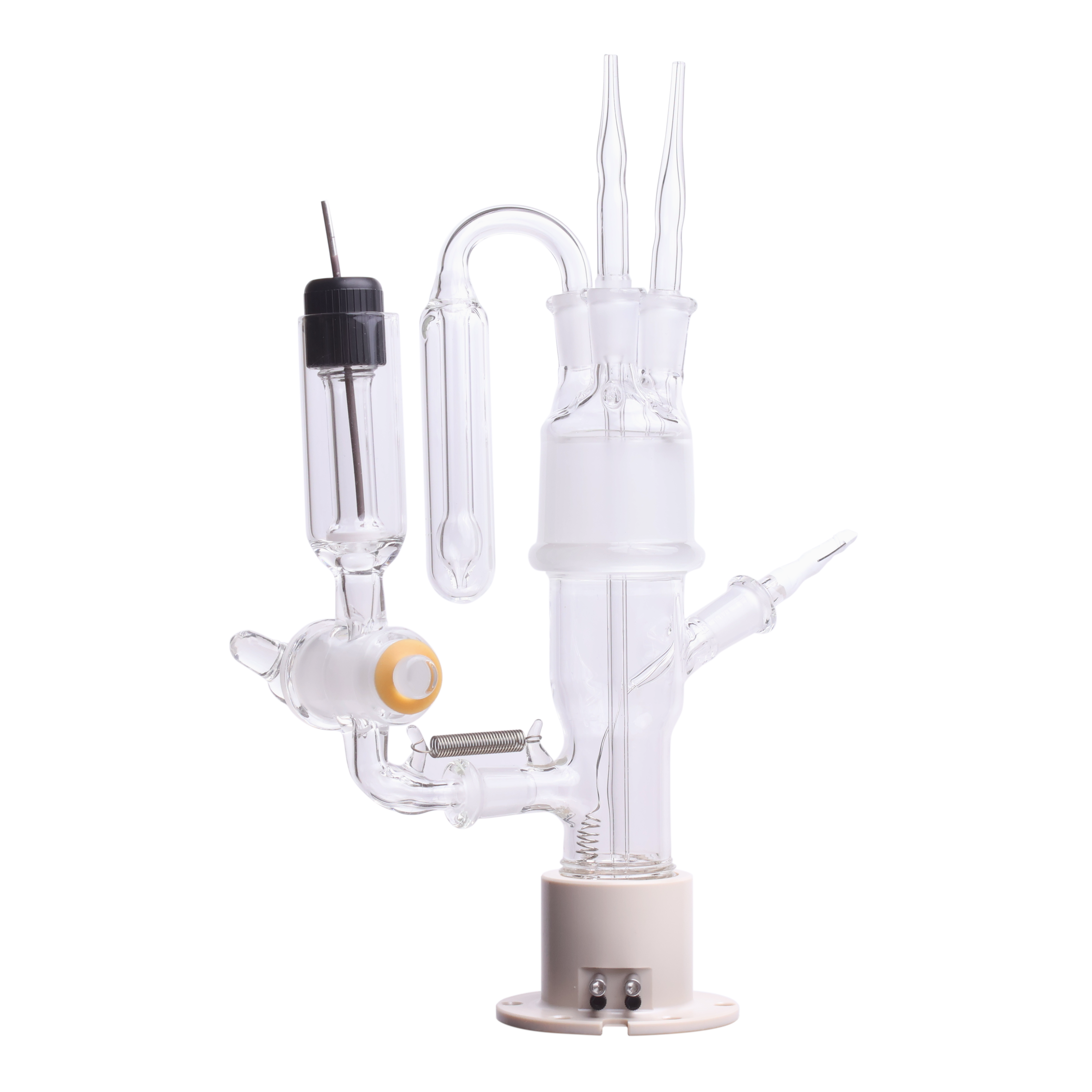
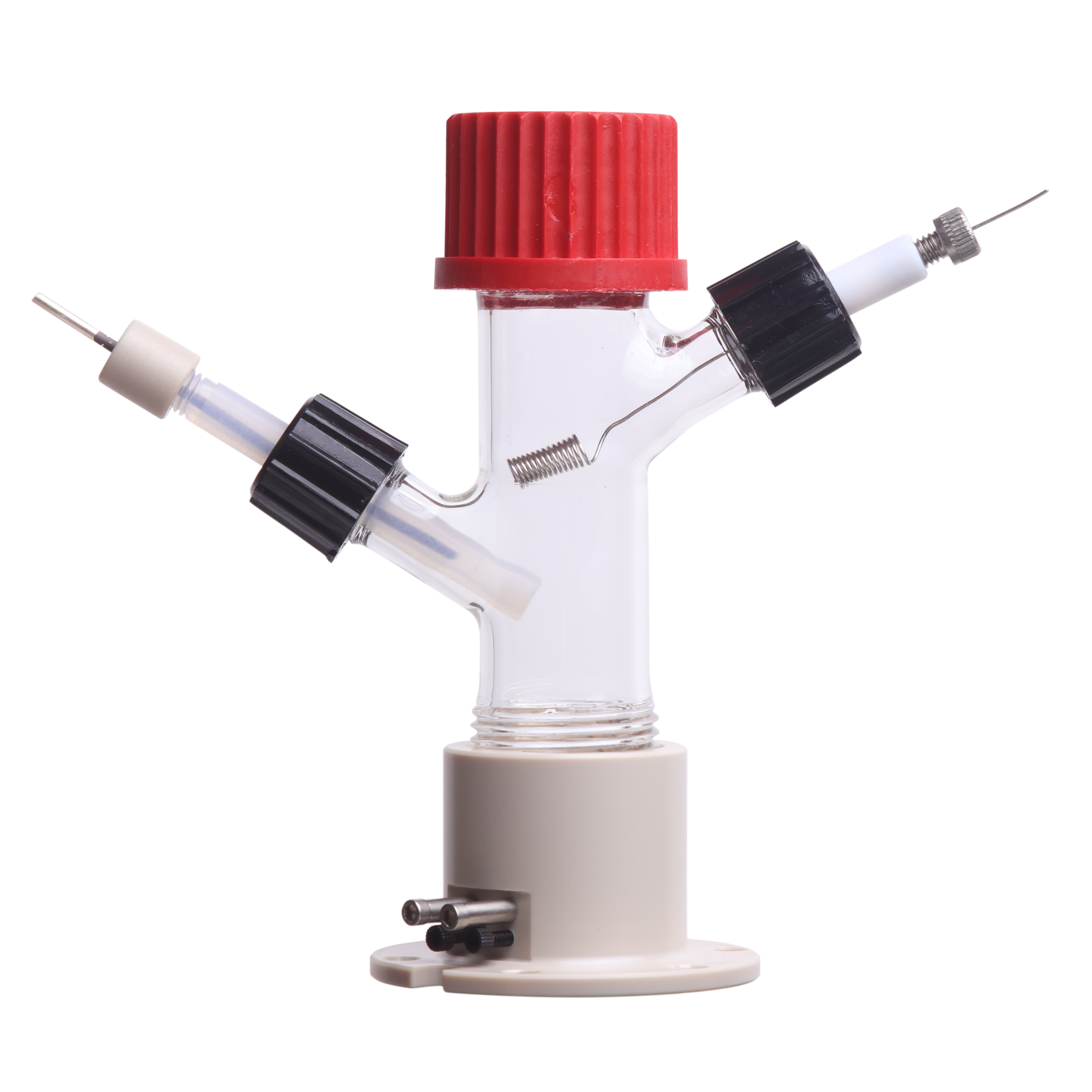
With the release of the J2 cell, you may be wondering which Jackfish cell is the most suitable for your research. The table below contrasts the features of the two cells to help you decide which cell might be a better fit.
J1
J2
Material Purity
All wetted components made of glass, FKM/FFKM, and PTFE/PEEK. All components can be rigorously cleaned according to standard electrochemistry procedures.
Under normal use, the wetted materials are glass, FKM/FFKM, and PTFE/PEEK. The PTFE-coated rubber septum is exposed to solvent vapours. Celcon compression caps cannot be acid washed.
Electrolyte options
Ground glass joints designed for use with aqueous electrolyte.
Completely sealed cell design is compatible with volatile solvents.
Counter electrode
Jackfish offers a choice of Pt or Au CE. Extra 7/14 ground glass joints are supplied for users to utilize a metal wire of their choice.
Pt CE available as an add-on. Standard 6 mm diameter compression-style fitting accommodates a variety of third-party electrodes.
Reference electrode
Reference arm is separated with a stopcock which acts as a salt bridge, preventing migration of RE filling solution into the cell body.
Jackfish offers Ag/AgCl RE, or the user can supply their own to fit in the 18 mm ID reference arm.
Electrodes are inserted directly into the cell in close proximity to the working electrode, reducing the impedance.
A standard 6 mm diameter compression-style threaded port accommodates a variety of aqueous and non-aqueous commercial electrodes.
Air-sensitive chemistry
Only possible by greasing the ground glass joints. Wetted ground glass joints slowly evaporate water to the environment and are unsuitable for use in a glovebox.
Completely sealed design can be used with Schlenk technique, or in a glovebox.
Minimum cell volume
20 mL (including reference arm)
10 mL
You might also want to check out our product release video for the J2 which walks through the differences between the cells in a bit more detail.
If you can’t decide which cell is best for you, or if you want to take advantage of the features of both cells, we do offer a combo discount available if both cells are purchased at the same time.